
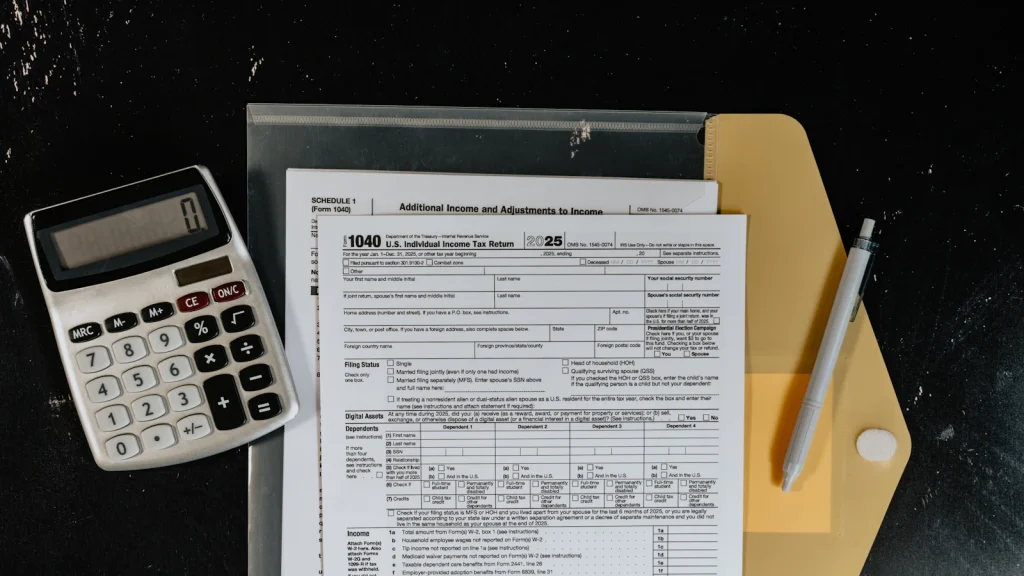
Cook County property taxes are paid a year behind, so when you sell, part of the taxes for the time you owned the house haven’t been billed yet. At closing, you give the buyer a credit for that share, and the buyer pays the bills when they arrive. Any past-due taxes are paid off from your proceeds before the deed changes hands.
The short answer
In Cook County, the tax bill you pay this year covers last year. At closing, the seller credits the buyer for every day the seller owned the home that hasn’t been paid for yet. That usually means the unpaid part of last year plus this year up to the closing date. The credit is normally estimated from the most recent full-year tax bill, often multiplied by an agreed percentage, such as 105% or 110%.
Why are Cook County property taxes paid a year behind?
Illinois bills property taxes in arrears. The 2025 tax year, for example, is being paid in 2026. Cook County splits each year into two bills:
- First installment. This is an estimate equal to 55% of the prior year’s total tax. For tax year 2025, it was due April 1, 2026.
- Second installment. This is the balance, based on the new assessment, tax rates and exemptions. For tax year 2025, the Cook County Treasurer lists the due date as October 1, 2026.
Second installment bills are normally due in early August, but they have run late in recent years. The tax year 2024 second installment wasn’t due until December 15, 2025. You can check current dates on the Cook County Treasurer’s important dates page. Late installments are charged 1.5% per month.
How does property tax proration work at closing?
Your sales contract sets the method. Most Chicagoland contracts prorate based on the “most recent ascertainable” full-year tax bill, times a percentage the parties agree to. A higher percentage protects the buyer against a tax increase and makes the seller’s credit larger.
The credit has two parts:
- Last year’s unpaid share. If the second installment for the prior year hasn’t been billed or paid, you credit the buyer for it.
- This year to date. You credit the buyer for January 1 through the closing date of the current year, since that bill won’t come out until next year.
If a bill is already out and unpaid at closing, the title company typically pays it straight from your proceeds instead of giving a credit for it.
A simple proration example
These numbers are made up to show the math. They are not real tax figures.
- Most recent full-year bill (tax year 2024): $5,000
- Contract proration: 105%, so the estimated yearly tax is $5,250
- Closing date: July 1, 2026
- Tax year 2025 first installment already paid: $2,750 (55% of $5,000)
Part 1, rest of 2025: $5,250 estimated for 2025, minus the $2,750 already paid, leaves a $2,500 credit.
Part 2, 2026 to date: January 1 through June 30 is 181 days. $5,250 × 181 ÷ 365 = about $2,603.
Total credit to the buyer: about $5,103. That amount is subtracted from what you receive at closing. It isn’t an extra cost. It is your share of taxes you would have paid anyway if the bills were current.
Your attorney may count days slightly differently, and the result shifts if the closing falls after a bill comes out.
What happens to your exemptions when you sell?
Exemptions lower your equalized assessed value, which lowers the tax. The Cook County Assessor lists these common ones:
| Exemption | What it does | Renewal |
|---|---|---|
| Homeowner | Reduces assessed value by $10,000 if the home is your main residence on January 1 | Automatic while your residency stays the same |
| Senior | Reduces assessed value by $8,000 for owners 65 or older | Automatic |
| Senior Freeze | Freezes the assessed value for qualifying seniors with household income of $65,000 or less | Must be filed every year |
Exemptions belong to the owner who qualifies, not to the house. After the sale, the buyer applies in their own name. If you no longer qualify, the Assessor offers an Exemption Removal Waiver. If you are a senior who moved during the year, you may be able to get a prorated senior exemption by sending the application, your closing statement and proof of age and residency.
Exemptions also matter at closing. If your last bill was low because of a senior or freeze exemption, the buyer may ask for a bigger credit, since their bill won’t have that break. Settle that question in the contract, not at the closing table. This can come up when a home is sold after the owner moves to assisted living or when you sell an inherited house.
What if you are behind on property taxes?
Unpaid property taxes stay with the property. At closing, the title company pays them off from your proceeds, along with any interest, just like a mortgage payoff.
If taxes stay unpaid long enough, the Cook County Treasurer offers them at the annual tax sale. The next one listed on the Treasurer’s site is December 15, 2026. A tax buyer pays the delinquent taxes and gets a certificate on the property, and you then have to redeem by paying the amount due plus interest and fees. If the taxes aren’t redeemed in time, the owner can lose the home through a tax deed.
Selling before the sale, or during the redemption period, is one way to protect your equity. We cover your options in more detail on our behind on property taxes page. If you are also behind on the mortgage, see our page on how to stop foreclosure in Chicago.
What changed in the 2026 tax sale law?
On July 10, 2026, the governor signed House Bill 4537, now Public Act 104-0553, effective immediately. It moves Illinois toward a system where tax-foreclosed homes are sold at public auction and any amount above the tax debt goes back to the former owner. It also lengthens the initial redemption period by six months to three years, creates a fund for people who lost equity in recent tax foreclosures, and sets up a Cook County pilot program. Parts of it phase in over several years, so if your taxes have already been sold, talk to the Treasurer’s Office or an attorney about how it applies to you.
How selling to us works with property taxes
The proration is the same whoever buys your house. It is your share of the taxes, so it shows up on any closing statement. What we change is the rest: we pay the normal closing costs and all transfer taxes, and there are no commissions or fees. We show you the math behind our offer, so you can see your bottom line before you sign.
We buy as-is, with a fair cash offer within 24 hours and the math shown. We can close in as little as 2–3 weeks, which can matter when a tax sale or redemption deadline is close, or on the date you choose at a local title company. We buy across Cook County, and our FAQ answers common questions.
If your taxes are current, your house is updated and you have time, listing with an agent may bring a higher price. That is worth comparing.
Want to see what you would walk away with after taxes? Ask for a free, no-obligation cash offer, or call or text (773) 825-9855.
This guide is general information, not legal or tax advice. Talk with a real estate attorney or tax professional about your specific situation.